
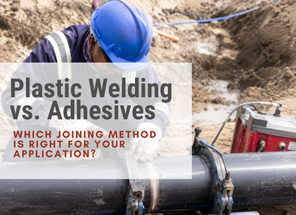
Plastic Welding vs. Adhesives
Plastic Welding vs. Adhesives: Which Joining Method Is Right for Your Application?
By B. Decker | Total Plastics | Industrial Fabrication
When joining plastic parts, the choice between plastic welding and adhesive bonding determines durability, cost, and assembly reliability. Choose the wrong method and you face joint failure, rework costs, or parts that can't survive their service environment. Choose correctly and you get a bond that lasts the life of the assembly.
Our guide gives product engineers and production managers a direct, data backed comparison of both methods. Including strength benchmarks, material compatibility, cost drivers, and an easy to understand decision framework for common application situations.
The Three Main Plastic Joining Methods
Industrial plastic joining typically falls into three categories:
- Mechanical fastening: bolts, rivets, snap-fits, and clips. Fast and reversible, but adds stress concentrations and isn't airtight.
- Adhesive bonding: structural adhesives, cyanoacrylates, epoxies, and UV cure systems. Requires surface prep and cure time.
- Plastic welding: hot gas, extrusion, ultrasonic, spin, or butt fusion. Results in a bond using heat and or pressure. Limited to compatible thermoplastics.
Mechanical fastening handles structural loads but introduces stress risers and sealing challenges. That makes the real decision for most precision and load bearing applications a direct comparison: plastic welding vs. adhesives.
Strength Comparison: The Core Data Point
Joint strength is where the two methods deviate from each other.
Plastic welding achieves 80 to 100% of base material strength. A correctly executed hot gas or butt fusion weld on polypropylene or polyethylene will create a joint that acts almost identically to the parent material. The weld zone becomes part of the structure, not an interface sitting on top of it.
Adhesive bonding typically achieves 30 to 50% of base material strength under the same structural conditions. That should not be looked at as a failing of adhesive technology. It reflects the physics of a surface dependent bond on low surface energy polymers like PP and PE.
For applications where that strength window is sufficient, adhesives work fine. For load bearing and high cycle applications, the gap matters.
Research by Weissenberg and colleagues on plastic joining methods documents this strength differential consistently across thermoplastic materials.
The data can also be found in the design guidance in standards like ISO 21307 (butt fusion welding of polyolefin pipes) and ASTM D3163 (lap shear strength of adhesive bonded rigid plastics), which provide different performance expectations for each joining category.
Advantages of Plastic Welding
Superior Durability Under Thermal Cycling
Welded joints expand and contract as a unified structure. Adhesive bonds create an interface between two materials with different expansion joints, and that interface is where fatigue starts after repeated thermal cycling.
For parts exposed to outdoor environments, process heat, or freeze/thaw cycles, welding is the more reliable solution for long term use. "A welded PP tank for chemical storage doesn't have an interface to fail," as Total Plastics' fabrication team routinely advises customers considering both methods. "The weld is part of the wall."
Best Material Fit: PP, PE, PVC, and ABS
Welding PP and PE is where the method shows its strongest performance advantage. These polyolefins are difficult to bond adhesively because of low surface energy. Even with surface activation (flame, plasma, or primer treatment), adhesive bonds on PP and PE are still weaker than on other polymers. Welding bypasses that limitation completly.
PVC welds using hot gas methods and is a standard in plumbing, chemical tanks, and fabrication work. ABS welds ultrasonically and with solvent cementing. Even though solvent cementing is technically a dissolution-fusion process, and not a adhesive bond.
Load Bearing and High Temperature Applications
For structural plastic assemblies like tanks, ducting, machine guards, and equipment housings, welding provides the bond integrity adhesives are not able to match.
The same is true for elevated temperature service: most structural adhesives start losing strength above 60 to 80°C. Engineering grade welded joints in polypropylene or PVDF keep their structural integrity at process temperatures above that threshold.
Bond Permanence
Welded joints are permanent by design. For assemblies that should never be disassembled, that is a feature, not a constraint. Adhesive bonds can degrade over time through UV exposure, moisture absorption, chemical attack, or simple fatigue. Or failure modes that don't apply to a properly executed weld.
Advantages of Adhesive Bonding
Joining Dissimilar Materials
Welding requires compatible materials, you are not able to weld polycarbonate to HDPE or acrylic to PVC. When your assembly calls for joining two different polymers, or a plastic to metal, glass, or composite, adhesive bonding is the only thermal joining option there is. Structural epoxies and methacrylate adhesives work well across mixed material assemblies and are used in electronics, medical devices, and transportation components regulary.
Precision Component Assembly
Thin wall parts, clear assemblies, and intricate geometries that can not tolerate the heat or pressure of welding are good candidates for adhesive bonding. UV cure adhesives allow precise placement and quick fixturing, which makes them standard in optical and medical assembly work.
Lower Equipment and Training Costs, Initially
A hot gas welding setup, extrusion welder, or ultrasonic system will require capital investment and operator training. Entry level structural adhesive bonding will require a dispenser, surface prep materials, and cure time, the initial cost of equipment is much lower.
High volume adhesive bonding operations have their own infrastructure requirements: climate controlled bonding areas, part fixturing, cure ovens, and strict surface prep process controls.
Faster Setup for Prototyping and Low Volumes
Small batch fabrication, R&D assemblies, or prototyping, adhesive bonding often gets a part into testing faster than welding. There's no preheat time, no bead dressing, and no post weld cooling period.
Decision Matrix: Choosing the Right Method
The following matrix summarizes the key decision factors and which method each favors:
| Decision Factor | Favor Plastic Welding | Favor Adhesive Bonding |
|---|---|---|
| Material type | PP, PE, PVC, ABS, PVDF, HDPE | PC, acrylic, mixed-material, metal–plastic |
| Structural load | High load-bearing; near-100% joint strength required | Moderate loads; 30–50% base strength acceptable |
| Thermal exposure | Thermal cycling; elevated process temps (>80°C) | Ambient or mildly elevated; stable thermal environment |
| Chemical exposure | Harsh chemicals; long-term immersion | Limited chemical exposure; dry or sealed assemblies |
| Production volume | Medium to high volume; repeatable process | Low volume; prototyping; one-off fabrication |
| Joint geometry | Butt joints, T-joints, fillet welds; accessible seams | Thin walls; complex geometry; optical or precision parts |
| Equipment investment | Higher upfront; lower long-term consumables | Lower upfront; ongoing adhesive and prep costs |
| Bond permanence | Permanent, non-reversible | Semi-permanent; some systems allow rework |
A practical example: for a load-bearing PP automotive bracket exposed to under-hood thermal cycling, welding provides the reliability adhesives cannot guarantee. For a clear polycarbonate housing bonded to an aluminum chassis in a temperature-stable electronics enclosure, structural adhesive is the right choice.
Safety Considerations and Operator Training
Plastic Welding Safety
Hot gas and extrusion welding generate fumes from heated thermoplastics. Adequate local exhaust ventilation (LEV) is required, particularly for PVC, which releases hydrogen chloride when overheated, and fluoropolymers like PVDF, where thermal decomposition produces toxic compounds.
Operators need respiratory protection, thermal burn PPE, and formal welding technique training.
Butt fusion welding of pipe and sheet follows standardized procedures under ISO 21307 and related standards, which specify heating plate temperatures, fusion pressures, and cooling protocols. Deviating from these parameters produces welds that look correct but fail under pressure.
Adhesive Bonding Safety
Structural adhesives introduce VOC exposure, skin sensitization risks (particularly with isocyanate-based systems and methacrylates), and flammability concerns during surface prep using solvents. Surface activation methods like flame treatment and plasma require their own safety protocols.
Both methods require documented safety training and SOPs. The assumption that adhesive bonding is inherently safer than welding isn't reliable, it depends heavily on the specific chemistry and ventilation conditions involved.
Frequently Asked Questions
Can I weld plastic to plastic reliably?
Yes: provided the materials are compatible thermoplastics. PP to PP, PE to PE, PVC to PVC, and ABS to ABS all weld reliably using appropriate methods. You cannot weld dissimilar polymers together (e.g., PP to PVC) using standard fusion welding. Material compatibility charts are available from resin manufacturers and welding equipment suppliers.
What's the difference in cost between plastic welding and adhesives?
For small volumes, adhesive bonding is typically lower cost upfront, minimal equipment investment, no operator certification required. For medium to high volume production, welding often becomes more economical: lower ongoing consumable costs and faster cycle times per joint. Total cost of ownership, including rework rates and joint failure risk, tends to favor welding for structural applications.
Which method works best for PP and PE?
Plastic welding is strongly preferred for PP and PE. Both materials have very low surface energy, making adhesive bonding difficult and unreliable without significant surface activation. Hot gas welding, extrusion welding, and butt fusion are all proven and standardized for polyolefin joining.
Adhesive bonding of PP and PE is possible but requires aggressive surface treatment and delivers lower joint strength.
How do temperature and humidity affect adhesive bond strength?
Most structural adhesives lose strength at elevated temperatures, beginning above 60–80°C depending on the adhesive chemistry. High humidity can cause moisture ingress at the bond line, degrading adhesion over time, particularly on surfaces that weren't optimally prepared. Adhesive manufacturer datasheets specify service temperature ranges and environmental resistance ratings.
Always verify these against your actual service conditions.
What standards govern plastic welding and adhesive bonding?
For plastic welding, key standards include ISO 21307 (butt fusion welding of polyolefin piping), DVS guidelines (German Welding Society, widely referenced for thermoplastic welding procedures), and ASME B31.3 for process piping fabrication. For adhesive bonding, ASTM D3163 covers lap shear strength testing of adhesive-bonded rigid plastics. Always verify applicable standards with your fabrication partner and end-use specification requirements.
Is there a scenario where I'd use both methods in the same assembly?
Yes. Complex assemblies sometimes use welding for structural joints between compatible thermoplastics and adhesive bonding where dissimilar materials or precision components are involved in the same unit. Hybrid joining is common in automotive, medical device, and electronics manufacturing. The decision for each joint should be made independently based on the criteria above.
Does joint design differ between welding and adhesive bonding?
Significantly. Welded joints are designed for butt, T, corner, or overlap configurations with specific groove geometries and fit-up tolerances. Adhesive joints rely on maximizing bond area and minimizing peel and cleavage stresses, lap joint design is the standard.
Specifying a joint without considering which method will be used is a common design error that creates fabrication problems downstream. Total Plastics' fabrication team can review joint designs during the pre-production planning phase.
Total Plastics' Fabrication Expertise
Total Plastics offers both plastic welding and precision fabrication services for industrial customers across the Midwest and beyond. Whether you're evaluating joining methods for a new design or troubleshooting a joint failure in an existing assembly, the fabrication team works directly with engineers to select and qualify the right approach.
For more context on related fabrication decisions, see our articles on precision plastic fabrication and cutting services and machining PTFE and fluoropolymers.
The Bottom Line
For load-bearing applications in PP, PE, or PVC, particularly those involving thermal cycling, chemical exposure, or long service life, plastic welding is the higher-performance choice. It delivers 80–100% of base material strength and creates a joint that's structurally indistinguishable from the parent material.
For assemblies involving dissimilar materials, precision components, or situations where welding equipment and operator training aren't available, adhesive bonding provides a viable path with the understanding that joint strength and long-term durability will be lower.
The decision isn't always obvious, and it's worth getting right before tooling and production are locked in. Total Plastics works with product engineers and production teams at the design stage to make that call correctly.
About the Author
B Decker is a Digital Content Specialist working with Total Plastics, with five years of focused content production for the industrial plastics distribution sector and a decade of broader industrial-sector writing experience. B's work covers materials science explainers, fabrication and machining guidance, specification support, and application case studies across thermoplastics, engineering plastics, and composites.
This article is for informational purposes only. Material selection, tolerance specifications, machining parameters, and finished-part qualification must follow project specifications, manufacturer datasheets, and applicable industry standards and certifications. Verify current standards, certifications, and material grades with the manufacturer and your fabrication partner before specifying.