

Coosa Board vs Plywood for Boat Restoration

Introduction to Coosa Board and Plywood in Boat Restoration
Boat restoration always comes down to one big question: what material are you trusting to hold up when the boat goes back in the water? That decision matters even more in structural areas where failure is expensive, dangerous, and frustratingly common. If you are rebuilding a deck, stringer, or using coosa board for transom replacement, the material you choose will shape how that repair performs for years.
For a long time, marine plywood was the default answer. It is familiar, relatively easy to source, and usually cheaper at the start of a project. But here’s the thing: plywood is still wood. Even high-quality marine plywood can eventually absorb moisture, break down internally, and develop rot or delamination when exposed to wet marine conditions over time.
That is why coosa board and other marine composite panels have become such a popular upgrade in modern boat restoration. Coosa board is engineered to solve the problems wood has always had in wet environments. Instead of relying on layered wood veneers and adhesives, it uses a closed-cell composite structure that resists water absorption and holds up under stress.
When people compare plywood and composite board for boats, they are really comparing durability, weight, installation, and long-term value. Both materials still have a place. But if your goal is a stronger, lighter, more moisture-resistant repair, Coosa board deserves a serious look.
Comparing Coosa Board and Plywood: Key Evaluation Criteria
Coosa board and plywood are built very differently, and that difference shows up fast in real-world marine use. Traditional plywood is made from wood veneers bonded together with adhesive. Coosa board, by contrast, is one of the newer marine composite panels designed specifically to resist the problems that come with water, weight, and long-term structural fatigue.
One of the biggest differences is moisture resistance. Plywood can perform well when it is sealed properly, but it still carries long-term risk because it is a wood product. Once water finds a way in, the material can start to soften, separate, and fail internally. Coosa board does not absorb water the same way, which is a major advantage in high-moisture environments.
Weight is another major factor. In many applications, Coosa board weighs about 40% less than marine plywood of similar thickness. That lighter weight can improve handling, fuel efficiency, and overall boat performance, especially in structural repairs where every pound matters.
Installation also deserves attention. Coosa board machines much like wood, which makes the transition easier for both DIYers and professional fabricators. At the same time, it is still a composite, so fastening techniques and hardware choices matter more than they do with traditional wood products.
If you are researching a Coosa board alternative or trying to decide which material actually makes sense for your rebuild, these are the categories worth focusing on: strength, weight, water resistance, workability, and total long-term cost.
Strength and Durability: Is Coosa Board Stronger Than Plywood?
Yes, in many marine applications, Coosa board is stronger than plywood where it matters most. The real advantage is not just raw strength on paper. It is the combination of strength and lower weight, which gives Coosa board a better strength-to-weight ratio in demanding boat repairs.
Its composite structure offers about 30% greater flexural strength than comparable plywood, which makes it a strong fit for structural applications that deal with repeated stress, vibration, and impact. That is a big reason why so many builders and restorers turn to coosa board for transom replacements and other high-load marine repairs.
What that means in practice is simple: the material holds its structure without carrying the same long-term moisture risk as wood. Plywood may start out strong, but once water gets into it, the clock starts ticking. Rot, swelling, and delamination are not just cosmetic issues. They are structural problems waiting to show up at the worst time.
Coosa board avoids that cycle. It does not rely on wood fibers and glue lines that can break down under constant marine exposure. That is why composite materials and marine grade plastics continue to replace plywood in transoms, decks, and other moisture-prone structural areas.
Some buyers start by searching for terms like coosa board home depot, hoping it will be easy to source locally. In reality, availability is usually better through specialty marine and composite suppliers that carry the grades and panel sizes serious restoration work requires.
Weight Considerations: Coosa Board vs. Plywood
If reducing weight is part of the goal, Coosa board has a clear advantage over plywood. In many restoration projects, coosa board transoms come in roughly 40% to 60% lighter than comparable plywood builds. That is a meaningful difference, especially in the stern where excess weight can affect performance.
A lighter transom can improve handling, help the boat plane faster, and reduce strain on the engine. It can also help correct stern-heavy tendencies that many older or rebuilt boats struggle with. In some cases, that weight reduction translates into better fuel efficiency and a more responsive ride overall.
This is one of the biggest reasons marine composite panels are so appealing. They can provide structural performance without depending on bulk and density the way wood often does. You are not just removing weight for the sake of it. You are improving the strength-to-weight balance of the repair.
That said, weight is not automatically everything. Some boats were designed around the mass of traditional materials, and in certain cases that extra density can still serve a purpose. So while Coosa board has the edge here, it is still worth looking at the boat’s design, balance, and intended use before making the final call.
Cost Analysis: Coosa Board Price and Value
Let’s address the obvious concern: coosa board price is higher than marine plywood. There is no way around that. In many cases, Coosa board costs two to three times more up front than marine-grade plywood. For budget-conscious buyers, that can feel like a deal breaker at first glance.
But the upfront material cost only tells part of the story. Plywood may be less expensive to buy, but it often comes with additional sealing steps, more maintenance concerns, and a greater chance of future replacement if moisture gets in. Coosa board changes that value equation because it is built to resist the exact issues that usually shorten the life of a wood-based repair.
That is why many professional builders look at Coosa board as an investment, not just an expense. Fewer moisture-related failures mean fewer callbacks, fewer repeat repairs, and more confidence in the finished job. For DIY boat restorers, it can mean doing the repair once instead of doing it over again a few years later.
In high-stress structural applications, the long-term value is often where Coosa board makes the strongest case for itself. When you factor in labor, downtime, future repair costs, and the consequences of material failure, the higher initial price can start to look a lot more reasonable.
Installation and Workability: Ease of Use for DIYers and Professionals
Coosa board is easier to work with than many people expect. One of its biggest practical advantages is that it can be cut, drilled, and shaped using standard woodworking tools, which makes the learning curve much less intimidating for both experienced builders and first-time restorers.
It cuts cleanly and does not have the same kind of inconsistent internal structure that can show up in plywood. Because the material is uniform, you are less likely to run into voids, weak spots, or unpredictable density changes during fabrication. That consistency alone can make layout and installation more reliable.
There is still a difference, though. Coosa board is not wood, so it should not be treated exactly like wood. Fastener selection matters, adhesive compatibility matters, and high-load areas need proper installation techniques. Sharp tools are important, and many fabricators prefer carbide-tipped blades for cleaner cuts and longer blade life.
Even with those considerations, the workability is a real plus. In many projects, installers find that Coosa board helps cut down installation time because there is no need for the same moisture sealing process required with plywood. That can save time up front and reduce headaches later.
Comparison Table: Coosa Board vs. Plywood
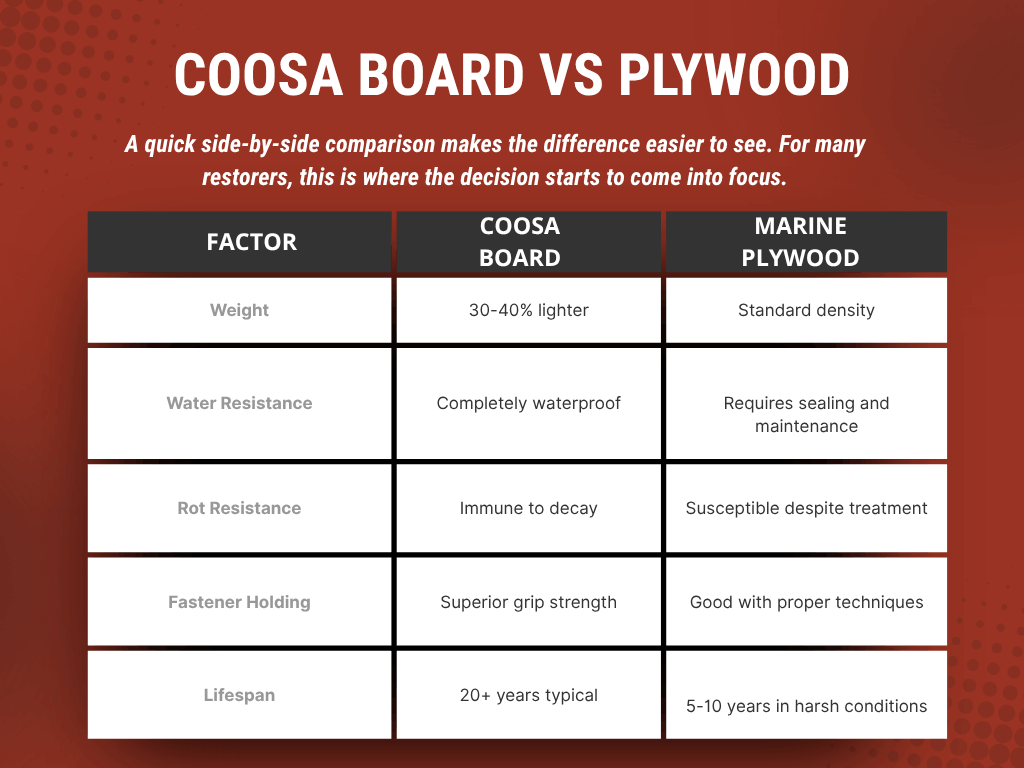
The gap becomes even more obvious in structural marine repairs where moisture, vibration, and repeated stress are part of daily use. Under conditions that can start breaking plywood down within months, Coosa board is built to keep its shape and structural integrity.
People also frequently search for terms like coosa board home depot 4x8 because they want a quick local pickup option. In most cases, though, serious restorers get better results through specialty composite suppliers that consistently carry the right materials for marine work.
Trust and Limitations: When Coosa Board Might Not Be the Right Choice
Coosa board is not automatically the best choice for every single boat repair. It has real advantages, but it also has limitations that should be weighed honestly.
The first is cost. If the repair is non-structural, temporary, or heavily budget-driven, marine plywood may still be the more practical route. Not every project needs a premium composite material, and pretending otherwise does not help anyone make a smart decision.
The second is application fit. Some designs may benefit from the extra mass of plywood, and some builders may prefer traditional materials in specific scenarios where they already know exactly how those materials behave. In other words, lighter is often better, but not universally better.
Availability can also be a challenge. Searches for coosa board near me are common, but local stock can be hit or miss depending on the market. For many buyers, ordering through a specialty marine or composite distributor is the more realistic option.
There are also technical considerations. Certain fasteners and adhesives interact differently with composite materials than they do with wood grain, and some extreme heat applications may still lead builders to lean toward more traditional materials with a long history in those exact conditions.
So no, Coosa board is not the answer in every situation. But when moisture resistance, long-term durability, and lower weight matter most, it is often the smarter material for the job.
Key Takeaways
The Coosa board vs plywood decision comes down to what you value most in the repair. If your top priorities are moisture resistance, lower weight, and long-term structural performance, Coosa board has a strong case.
It offers a better strength-to-weight ratio than plywood, resists water intrusion, and eliminates many of the rot and delamination risks that make wood repairs fail over time. That makes it especially attractive in transoms, decks, and other structural marine applications where durability is not optional.
Plywood still has a place. It is cheaper up front, more familiar to many installers, and can work well in less critical applications. But once labor, maintenance, and replacement risk are factored in, the higher upfront cost of Coosa board often becomes easier to justify.
At the end of the day, the best material is the one that matches the demands of the project. For moisture-prone structural repairs, Coosa board is often the better long-term solution.
Frequently Asked Questions
Is Coosa board really stronger than plywood for marine applications?
Yes. Coosa board is stronger than plywood in terms of strength-to-weight ratio, and it maintains that performance in wet marine environments where plywood can deteriorate. Its composite construction helps prevent delamination and rot, which is a major advantage in structural repairs.
What’s the typical price difference between Coosa board and marine plywood?
Coosa board price is usually two to three times higher than marine-grade plywood initially. Even so, the longer lifespan and reduced maintenance needs can make it the better value over time.
Can I find Coosa board locally, or do I need to order online?
If you are searching for coosa board near me, you may find limited stock through local marine supply stores, but online ordering from specialty composite suppliers usually gives you better selection, sizing, and availability.
Does Coosa board require special tools or techniques for installation?
Standard woodworking tools work well for most fabrication. Carbide-tipped blades are often recommended, and fastening methods should be chosen carefully for structural or high-load applications because Coosa board is a composite, not a wood panel.
How does Coosa perform in extreme temperature conditions?
Compared with plywood, which can expand and contract more significantly, Coosa board remains stable across a broad temperature range from -40°F to 200°F. That stability makes it a reliable option in a wide range of marine climates.